The Meetings You're Not Having Are Giving You Time to Think
How written culture creates the organisational intelligence that AI can actually use.
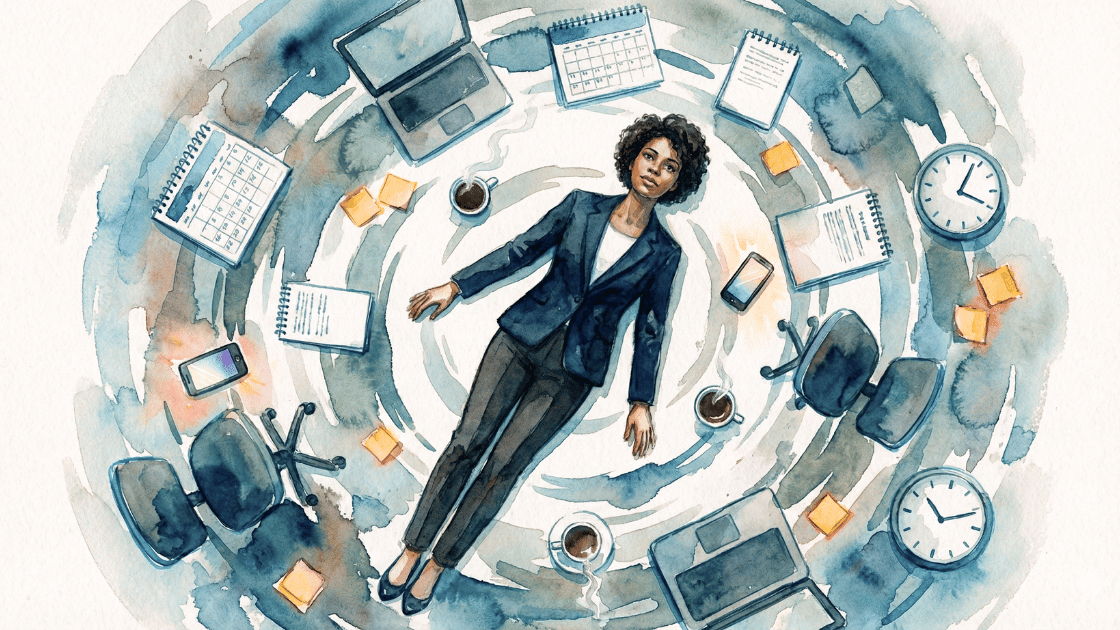
It’s one of those days; a typical day with back-to-back meetings, of which half of them could have been emails. You emerge at 5pm, unable to recall what was decided in any of them, wondering where the day went.
I've been there, too. Most of us have.
But as the calendar fills, decisions blur and institutional knowledge is left on the table, leaking out through the gaps between the thoughts that nobody captured.
What if there were another way?
The Intelligence Illusion
There's a belief baked into most organisations that gathering smart people in a room produces smart outcomes. The meeting is supposed to be where the magic happens.
In my experience, however, the opposite is often true. Meetings reward the quick thinker over the deep thinker, the confident voice over the considered one, the person who speaks first, not the person who's thought longest.
And then the meeting ends. What was said? What was decided? Who's accountable? As we rush to the next meeting, we’re often too busy to even care.
OK, these days, we now have AI tools that can transcribe our meetings, extract the action items, summarise the decisions. This helps with the admin burden. But if you watch carefully, you'll notice they capture and synthesise the words. They don't improve on the thinking.
This meeting dysfunction is something most organisations treat as the inevitable cost of doing business. But a French health insurance company called Alan has taken a path that challenges everything we assume about how work should happen.
What Alan Actually Did (And How They Got There)
Alan was founded in 2016 and became the first independent health insurance company licensed in France since 1986. Today they serve over 973,000 members across France, Belgium, Spain and Canada, with €693 million in annual recurring revenue as of Q3 2025.
But here's what makes them unusual? They have almost no internal meetings.
This wasn't the plan from day one. According to CEO Jean-Charles Samuelian-Werve, they started with traditional meetings like everyone else. But about eight months in, through a friend's recommendation, they discovered GitHub Issues as a decision-making tool and fell in love with it.
This evolution is important because it didn't start with an ideology or fixed plan. It was experimentation, driven by curiosity and consistency, that stuck.
Instead of gathering people in a room, someone with a decision to make opens an "Issue" which follows a consistent structure: Goal, Context, Proposal, Questions. Anyone relevant gets tagged. Anyone interested can contribute. Discussion happens asynchronously.
The decision is made in writing, and crucially, it stays there as a searchable, accessible, and always available library of the company’s decision-making knowledge and intelligence.
By around 2020, they had documented over 7,500 decisions this way. Today, with over 650 employees, the number is a significantly higher 33,000.
You'd think that this process is just for engineers, but it's not. It is used by sales teams, customer care and even designers. It tracks everything from budget decisions, and strategy questions to offsite planning, applying the same consistent format across the entire organisation.
"It's so ingrained in people that now, if you make a decision, and it's not written down, it just didn't happen."
That's from Deborah Rippol, who led talent acquisition at Alan during their formative years, capturing how the company culture became self-reinforcing. It's an impressive example of real discipline and commitment in action.
How Writing Forces Clarity
When you have to put an idea in writing, you can't hide behind charisma or confidence. Writing forces you to consider the gaps in your logic and articulate your ideas with a clarity that requires no additional explanation. It's a process that decelerates your mind and demands your attention so that you pick up on assumptions and ambiguities that you otherwise may have glossed over.
As Samuelian-Werve puts it:
"Writing forces us to put things down and take the time to think."
Alan isn't alone in recognising this. In 2004, Jeff Bezos banned PowerPoint presentations at Amazon, replacing them with six-page narrative memos that meeting attendees read silently for 30 minutes before any discussion begins. His reasoning echoes Alan's philosophy.
"The narrative structure of a good memo forces better thought and better understanding of what's more important than what, and how things are related. PowerPoint-style presentations somehow give permission to gloss over ideas." Jeff Bezos
Both approaches share the core insight that the act of writing well is inseparable from the act of thinking well. And there's something else happening here that's worth considering. In a meeting, intelligence is concentrated in that one room, that single call or video session. Traditionally, when tasks are allocated or decisions are made, no one wants to take on the housekeeping job of documenting and following up. But when decisions are written and visible in a central repository, when others can question and comment on them, then accountability and intelligence becomes a distributed force across the organisation.
The quiet analyst who never speaks up in meetings can add their perspective, the veteran can share their reservations, the new hire can learn from years of documented decisions. Knowledge compounds instead of lying lost, unused and gathering dust in countless inboxes.
Transparency Enables Ownership
The deeper organisational logic at work here is what Alan calls "distributed ownership". Everyone is expected to make decisions, not defer them upward.
But distributed ownership only works if people have access to the information they need to make informed decisions. You can't ask people to take responsibility if you're gatekeeping the context required to exercise it. Written culture solves this by making every decision visible and documenting every rationale. Anyone can understand not just what was decided, but why.
Alan extends this further than most would dare. Even board minutes are visible to employees and salary formulas are openly accessible. Everyone has a say across all levels, and this holds dividends for the organisational culture. If you want people to act like owners, give them the information and the empowerment that owners have.
Samuelian-Werve has described this as creating "enlightened despots" throughout the organisation. People who have full context and are willing to take calculated risks, while also accepting accountability for the outcomes.
It's a virtuous cycle in which transparency enables autonomy, autonomy demands transparency, and written culture makes both possible at scale.
What This Means for the AI Era
The emergence of AI is now exposing cracks in organisational structures that were perhaps not visible before. Although leaders are seeking to leverage AI, those struggling to reap benefits are dealing with a lack of organisational readiness.
Many have already adopted meeting transcription tools like Otter.ai, Granola, Fireflies, and dozens of others that can capture conversations, extract action items, and summarise decisions. These tools are genuinely useful. They solve a real problem, but while AI meeting tools capture what was said, they don't improve what was thought.
If meetings are dominated by the loudest voices, if people arrive unprepared and share randomly, if decisions emerge through social dynamics rather than rigorous reasoning, then a perfect AI transcription gives you a searchable archive of muddy thinking.
Alan's approach is different because it intervenes earlier in the process. When someone opens a GitHub Issue, they must articulate their Goal, Context, Proposal, and Questions before anyone else weighs in. The thinking happens in a quiet moment, without the social pressure of a room. Clarity is created preemptively via deep thought, rather than retrospectively by an algorithm.
There's an accountability difference too. When an Issue is raised, it has an author, someone who proposes and someone who decides. This makes the ownership explicit and personal. When an AI summarises a meeting, who owns that summary? Who's accountable for the "action items" it extracted? The responsibility diffuses across everyone who was in the room, which often means no one. This isn't to dismiss meeting tools. They're valuable for what they do. But they're a complement to structured thinking, not a substitute for it.
Alan's architecture goes deeper. Every decision is not just captured but structured. The knowledge base that results from this rigour isn't a pile of meeting summaries, it's a coherent, navigable record of how the organisation thinks. And that's what AI can actually build upon.
Their recent revenue results suggest this is paying off. In their latest letter to shareholders, they reported that 25% of customer care contacts are now handled by AI, while maintaining the same satisfaction scores as human support. Their Claim Agent now resolves 30% of claims-related tickets automatically. Their 2025 target: 40% automation across all contacts. These results don’t emerge from meeting transcripts, they're built on years of deliberately structured, written institutional intelligence.
The irony is that while many organisations are racing to implement AI tools, their underlying knowledge still remains locked in disparate, disconnected conversations, even if those conversations are now being recorded. It's not enough to simply capture your meetings. It's important to do the hard work of structuring your thinking before you meet at all.
The Knowledge Base as Organisational Foundation
What Alan has built, perhaps without using this exact language, is what I would call an organisational Knowledge Base. Not just a document repository, but a living system for capturing, organising, and retrieving institutional wisdom.
This is one of the foundational elements of my framework for AI-era organisations. Without it, you have experts who know things but can't share at scale. You have decisions that are made but then quickly forgotten. You have new hires who require months of onboarding to discover what veterans know intuitively.
Knowledge that flows multi-directionally between those creating it and those applying it is a solid foundation that AI can actually build upon.
The specific tool you use is less important. While Alan uses GitHub Issues and Amazon uses narrative memos, others use Notion, Confluence, or custom solutions. What matters more is the individual employee’s discipline and commitment to externalising thought in a consistent format, making it visible, and keeping it accessible. This is both the biggest strength and the biggest challenge when attempting to copy this approach in your own organisation. It’s Alan’s secret sauce, their unfair advantage and moat against other players in the market.
The Honest Trade-Offs
Alan's approach works brilliantly for Alan. But to be honest, the adaptation barrier is significant. Alan benefits from the fact that they built this culture relatively early, when they were a small team of people who self-selected into this way of working. Retrofitting Alan’s system in an established organisation with existing meeting rhythms, political dynamics, and communication habits is a fundamentally different challenge.
Several realities make this difficult:
- Writing proficiency varies dramatically. In meetings, people can contribute through verbal presence, body language, and real-time responses. Written culture demands comfort with articulating ideas in prose. Some of your strongest contributors may struggle here, at least initially. Alan acknowledges they've lost candidates who couldn't adapt to written communication, or didn’t have the English proficiency required across the company.
- Power dynamics shift, and not everyone welcomes that. Written forums flatten hierarchies. The person with twenty years of experience and the person with only two years have equal visibility. For some leaders, this feels like a loss of status. For some junior employees, it feels exposing.
- Leaders who favour speed over quality. Alan's approach optimises for decision quality and institutional memory, not necessarily for the fastest possible response. Synchronous conversations can resolve ambiguity in minutes that might take hours of async back-and-forth. Organisations in crisis mode or with genuinely time-sensitive operations may find this frustrating.
- Not everyone wants to work this way. And that's legitimate. Some people are genuinely better at organising their thoughts through discussion. Others find it exhausting to have to write everything down. Alan explicitly says they're looking for "missionaries, not mercenaries" and accepts that their culture isn't for everyone.
For Organisations Considering This Approach
If elements of Alan's model resonate with you, here are questions worth discussing internally before you take step one:
- What’s the actual problem? What specifically isn't working about your current approach? Is it decision quality? Inclusion of remote workers? Institutional memory? Different problems may warrant different interventions.
- How could we test this? Could one team experiment with written decision-making for a quarter? What would you learn? Alan itself didn't start this way. They discovered GitHub Issues eight months after founding and evolved their practice from there.
- What infrastructure is required? This isn't about simply banning meetings. It requires clear templates or frameworks (Alan uses Goal, Context, Proposal, Questions), searchable archives, and norms about response times. Without a proper structure, you just get chaos in a different medium.
- How long shall we set the transition period? People will complain. Others will ignore the new norms. Some decisions will take longer than they "should." Leadership needs to model the behaviour consistently and accept that culture change will have to be measured in years, not months.
- What can we do to maintain human connection? Alan still has 1:1 coaching conversations, team gatherings, and company events. Written culture doesn't mean there's no human contact at all. If anything, it makes the in-person time more precious and purposeful.
To be honest, Alan's approach is not the right one for most organisations. But that doesn't mean there's nothing to learn here. Even small shifts can be helpful. For instance, documenting the reasoning behind decisions, making information more accessible rather than gated, or questioning which meetings really need to happen.
The Gap That Matters
So here's an exercise for you. Look at your calendar for next weeks. Count the gaps, i.e. those stretches of uninterrupted time in which you could think deeply, work strategically, or focus on the activities that actually drive your business forward.
For most of us, those gaps barely exist. We move from meeting to meeting, context-switching between conversations, and never quite finishing a thought before the next one demands our attention.
Alan's experiment suggests that by filling the gaps in your knowledge base, you are creating gaps in your calendar. The more you externalise thinking into structured, searchable documentation, the fewer synchronous discussions you need. With fewer meetings, more time is made available for the work that meetings were supposed to enable in the first place.
Recording your meetings is a start. But the real question is whether you're doing the harder work: structuring your thinking before you meet at all, and reclaiming the time you'd have spent in that room.
Dawn Springett is the founder of Changentum and creator of the FORS (Forest-Orchard Resilience System) framework for AI-era organisational design. She works with leaders navigating the transition from expertise-dependent to system-driven enterprises. This article is part of a series exploring how pioneering organisations are structuring themselves for the AI era.
Subscribe to the FORS Report
Be the first to know - subscribe today



Member discussion